Thursday, November 09, 2006

when women pursue justice

is a fabulous mural on the side of building in bed stuy. it's bright, it's beautiful, it recently won a mural prize, it features a diverse cast of characters: angela davis, harriet tubman, elizabeth cady stanton, dolores huerta, audre lorde, many more. all of the women stood for something, this mural equates what they stood for with justice, but the most interesting part about it is that all of these women all stood for different things. justice, it appears, is a many-faceted thing.


the photo above is from imagingphotographics.com. the mural was a project of artmakers nyc, and it was completed a little over a year ago, in october 2005. brava for public art! this mural, in more ways than one, places itself in a longstanding tradition of visual resistance. it's not just decoration, making things look pretty. this is also public memory, because i certainly don't recall reading about angela davis or audre lorde in the history books in school, and it might be easy to forget what contributions they have made in their respective fields. many artists collaborated on the mural, and they picked the women they wanted to represent, so i would shy away from saying that the piece has a singular message. but the women who painted this also stood for something, and i admire that. the closeup below is from the artmakers website


Labels: , ,

Thursday, November 02, 2006

in memory of encyclopedia

obviousy, i love books. this is for the aristocracy of all books. if amiri baraka can write in memory of radio, i can write in memory of the encyclopedia.

true story time: as a kid, we had 3 sets of encyclopedia. i used to read through them, obviously not cover to cover, but just sit there and read articles. i loved those books: hard, textured leather covers, small text on perfect sheets of paper, distinctive coloring bands, their absolute order, their codified history.

encyclopedia's helped me develop my first sense of history. chocolate, buffalo, the west indies, christmas: i read all kinds of articles about things that interested me, and the fact that there was a distinguish book that bound all this info together made it seem seamless, and important. there was a wonderful finality about the encyclopedia.

and then: a new year brought a new additions to the encyclopedia. what a wonderful time to put things in perspective, to decide what from the previous year or years would be important to us moving forward into the next year, and whatever that might bring to us. the encyclopedia - it was fact incarnate.

and then: encarta. encarta killed the encyclopedia. microsoft encarta, that cd rom program that contained all of the information some shelves full of lovely encyclopedia books contained. that cd rom that took up so little space, and could easily be carried with you, and so brilliantly pointed up all of the flaws of the encyclopedia sets. those sets of encyclopedias to which i had become so attached.

these are some of the encyclopedia's flaws: there is nothing liberté égalité fraternité about the set of bound encyclopedias. either you have the money to buy a set, and keep buying sets if you value staying informed, or you do not. and of course, the old adage that history is written by the victors is perhaps never so true anywhere as in the encyclopedia - it being so intimidating, so expensive, its utter sense of finality, leaves no room for the non-victors to have a say. there was little rival to the encyclopedia. to be honest, i never really thought of the encyclopedia as such as status symbol. it really was. i loved the encyclopedia for its big words, obscure topics, and neat packets of information. because it made me feel like there was a lot to learn, not that because it made me feel important. there was a lot to learn, but the fact remained that there were only so many volumes to a set. you could, actually, read it all. and come to a point where you had mastered one year of history.

encarta: after awhile, you could even get encarta online, and that had oodles of brand spanking new information. i'll go out on a limb and say that with encarta, history was being written literally as it was being written. so there was no selectivity, no time for review, no time for perspective on what was actually important and what turned out to be not so important. in the long run. there was no more long run. there was only a short sprint to be the first to get the latest info into the hand of the masses.

more info is available to more people. wikipedia anyone? another true story: i often find myself reading wikipedia in the same way i used to read the encyclopedia as a kid. when i hear of a news event, i often look up the related topics on wikipedia, and all the details are already there. no waiting. no new editions. no shelf space, not even a cd rom this time around. so democratic, few filters...just a glut of information, so much informatin, still taking me to the place where i want to know more and more and more...but sometimes it's overwhelming. with the encyclopedia, i kinda felt like i could actually conquer it. all of it. with all wikipedia, i know i can't. i read it though. i turn to it daily.

but with wikipedia, i don't get to feel the contrast between textured leather covers and smooth pages between my busy, itchy, knowledge hungry fingers.

thanks to my good friend brandi for making me think deeply about the demise of the encyclopedia.

Labels: , ,

Monday, October 23, 2006

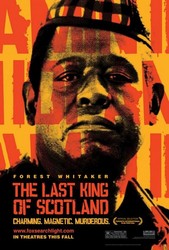
the last king of scotland

went to go see the last king of scotland on friday. came away from it feeling, at best, lukewarm. (my friend downright hated it...sorry bout that.)

The Last King of Scotland Poster
the last king of scotland, based on a novel of the same name, is the story of the (fictional) personal physician of idi amin. while i don't have a problem with fictional characters parading in and out of films inspired by or about real personages (malcolm x comes immediately to mind - all kinds of fictional folks there) the film suffered from being almost totally about the fictional person, and only skimming the surface of idi amin's story.

idi amin is quite possibly one of the most notorious leaders in recent history, and yet, for some reason the film pretends that his personal physician could be completely unaware of his ruthless tyranny.* unlikely that someone on the inside, whom amin trusted, could be so isolated. and his actions alone, without the frontloaded plot concerning the privileged, young scottish doctor nicholas garrigan's improbable sexcapades in uganda, could have occupied an audience.

the performances by the actors, however, were not disappointing. forest whitaker played an alarmingly captivating amin, and james mcavoy (who was wonderful as mr. tumnus in the lion, the witch, and the wardrobe) had the part of the bored, well-to-do european youth looking for some excitement (and changing the world and feeling real important in the process) down pat. i can't fault the actors here at all. and not even so much the writing, because the dialogue was great...i think that the film could have done with some judicious editing in the storyboard phase. or perhaps some reimagining of it's dramatic structure, because while the elements of a good film were there (premise, cast, crew, etc) the sum of film did not turn out to be more compelling than its parts.

*i mean really...in the previous post, tropicália, i briefly mentioned literary artistic anthropophagy (cannibalism), the artistic aesthetic of "eating" other aesthetics. idi amin, on the other hand, has been accused of actual cannibalism. yeah. and that, as monumentally shocking a charge that is, was just a footnote in this film. and literary cannibalism gets mountains written about it every year.

Labels: ,

Tuesday, October 17, 2006

catch a fire is....

my favorite bob marley song of all time. so when i heard that they were doing a movie by that same title i thought, please, don't let this just be random cultural commodification, especially for the sake of a craptacular movie.

and let me just say, catch a fire is definitely NOT that. went to a screening of it last night, and really really really enjoyed it, which is saying something because one of the projectors at the screening room broke (who knew bryant park hotel would have such poor equipment?) so we had to watch the film on one projector -- and films come on many reels, in the case of catch a fire, there were 5 reels, so that meant five breaks to switch the reels on the one working projector. these breaks were more than mildly annoying, but to think of it another way, it also means five moments when the audience might lose interest and leave. and that did not happen.

i found myself riveted. catch a fire is the story of what ordinary people are driven to do/become under extraodinary circumstances. many movies recently (syriana and paradise now come immediately to mind) examine what is it that makes pushes an ordinary human being (and let's face it, most human beings are quite ordinary) to become a terrorist. catch a fire makes a similar examination, but with two glaring differences. (1) the context for catch a fire is not the current middle eastern conflict, but the struggle to dismantle/maintain apartheid in south africa, and (2) this film is based on the true story of an actual individual, patrick chamusso. chamusso is played by derek luke, (antwone fisher in the eponymous film) who was brilliantly convincing in this role. his work stood up to comparision to the south african actors about him. bonnie henna played his wife precious, and the two had remarkable chemistry. chamusso is like the most typical suburban husband and father, loving, hardworking, not particularly political though not politically ignorant, even coaching a neighborhood soccer team. but is he capable of resisting apartheid? what would drive him to that point, when his life was so (comparatively) good?

tim robbins played a most deliberative police official who's job it is to suss out the "terrorists," anc activists. i thought it interesting that the word terrorist occured several times throughout the film - it seems that, since 9/11 terrorist is a word that everyone throws about freely. after the screening there was a q&a with the producer, robyn slovo, who said that there was no intentional insertion of the "war on terror" motif into the film - that's just the way that period in south africa played out.

robyn explained that the film was quite a personal labor of love. it was written by her sister, shawn slovo, based on the story of patrick chamusso, which mr. chamusso related directly to shawn. robyn and shawn's father, joe, was an anc activist who knew mr. chamusso personally, and remarked to his daughters that if ever a film about the struggle against apartheid was made, it should be about patrick chamusso. and his daughters obviously listened.

with films like this, it's deceptively easy to pick out your hero and villian conclusively. patrick chamusso is still alive, and at the end there is footage of him meeting derek luke, who plays him in the film. tim robbins's character, nic vos, is a composite character based on two security inspectors, who, as it turns out, refused to tell their versions of events to the truth and reconciliation commission. so i guess, in this case, mr. chamusso's version of events gets to be history (which is always written by the victors.)

i had to ask robyn about the title, why catch a fire? she said that bob marley's music resonated with anti-apartheid struggle of the era, and it resonated with the filmmakers personally. but i found it odd that the song catch a fire was never at all used in the film. o sure, there was plenty of bob marley music at the most climactic moments, especially could you be loved? and exodus. but catch a fire didn't even play during the credits. i suppose there is something to be said for the subtle tie-in...and i suppose there is something to be said about the fact that the title will also resonate with bob marley fans who may not know anything about south africa.

anyway, catch a fire opens oct 26 nationwide, and in feb 2007 in south africa. (ms. slovo said she believes it will be well-received in south africa, especially given the national climate/attitude that resulted from the truth and reconciliation commission, but south africa suffers from a severe dearth of cinemas in the rural areas.) go check it out. and if you care nothing for its social implications, it also has some good action sequences.

Labels: ,

Monday, October 02, 2006

this & that

couple of interesting stories i read today:

*an english woman filmmaker, penny woolcock, has interpreted the biblical account of exodus for a modern context, scripting it as a political struggle over immigration, and staged it as a massive public art performance involving an entire english town. sculpture, music, and theater - very interesting. i think it is quite intriguing. and while many people find the bible to old to be relevant, this project just goes to show that, in the end, human nature and the themes of our existence remain the same. there is nothing new under the sun...which is also a biblical phrase...so perhaps we should be learning something from the story.


*sunday, october 1 marked the 44th anniversary of the integration of university of mississippi, good old ole miss. james meredith, the first black student to enter the university, and morgan freeman were on hand for the commemoration.

Labels: ,

Thursday, September 21, 2006

culture jamming, mos def style

found this on trace212.com

Piece of Mind: Mos Def arrested at VMA's


Though it resulted in his arrest for disorderly conduct, big ups to Mos Def for having the best performance at this year's MTV Video Music Awards. The rapper/activist pulled up in front of Radio City Music Hall on a flatbed truck and boldly unleashed his politically charged "Katrina Clap", a song that targets Bush and his poor response to the devastation left in New Orleans. Unplanned and without the official MTV stamp of approval, the show went on even when asked to stop by NYC authorities, all of which led the arrest of Mos Def and most of his entourage. The revolution was not televised as part of MTV's programming but Mos Def's people did catch the events on tape and are working on publishing it for all to see.


"katrina clap" is on the beat of juvenile's "nolia clap," which is ridiculously fitting. listen here:
http://www.nobodysmiling.com/hiphop/promotional_audio/85087.php

http://www.trace212.com/data/news/200609061850.html

Labels: , ,

Wednesday, September 20, 2006

in the vein of never forgetting

found this article on yahoo news...

Museum honors Emmett Till in Mississippi

Wed Sep 20, 4:27 AM ET

Photographs that captured a mother's grief and Emmett Till's mutilated body were on display as this tiny Mississippi Delta town opened a museum honoring the slain black teenager whose death was pivotal in the civil rights movement.

Among the items on display are family snapshots and a picture of Till's mutilated body that stunned the nation after the 14-year-old Chicago boy was brutally murdered in 1955, allegedly in retaliation for whistling at a white woman.

"I want the country to see this moment as an historic event of how far we have come in the civil rights movement and to open people's eyes to the many other injustices that have happened in other places besides the Delta," said Till's cousin, Priscilla Sterling.

The town converted a cotton gin into the Emmett Till Historic Intrepid Center, which includes oral histories, an audio-visual archive and a cotton gin fan like the one used to weigh down Till's body after it was dumped in the Tallahatchie River.

Two white men were acquitted in Till's case by an all-white jury. The two men later confessed in an interview with Look magazine.

The FBI reopended the case in 2004 but decided in March not to press charges. The case was turned over to District Attorney Joyce Chiles for possible state charges. She did not return a call seeking comment.

The boy's case has never been forgotten in more then half a century.

The National Conference of Black Mayors commissioned the Till center as a model of revitalization for other small towns.

The museum also has a space dedicated to Glendora native and legendary blues harmonica player Sonny Boy Williamson.

A technological center will be opened at the site in a collaboration with Mississippi Valley State University.


Labels: ,

Friday, September 01, 2006

minority: this is the problem

i'm on a million listservs, and i just got this email containing a link to a very interesting article on yahoo, entitled: "Minorities seek history class changes." the article goes on to detail common misconceptions people hold because, as well all know, history is written by the victors. it says:

"American students often get the impression from history classes that the British got here first, settling Jamestown, Va., in 1607. They hear about how white Northerners freed the black slaves, how Asians came in the mid-1800s to build Western railroads. The lessons have left out a lot.

"Forty-two years before Jamestown, Spaniards and American Indians lived in St. Augustine, Fla. At least several thousand Latinos and nearly 200,000 black soldiers fought in the Civil War. And Asian-Americans had been living in California and Louisiana since the 1700s."

you can find the rest of the article here:

http://news.yahoo.com/s/ap/20060820/ap_on_re_us/forgotten_history

ok, so they've got me hooked with the first two paragraphs. and while it's not telling me anything new, its kinda nice to see old facts in the news if they are facts that people often deny, or at least skirt. but reading further, i came to this paragraph which absolutely made my head spin:

"Some tales have gone untold because, in the less-diverse America of the past, minorities didn't make the decisions on textbooks and other means of passing along history. And in many cases, minorities who had faced blatant discrimination wanted to discard evidence of past horrors."

the LESS-DIVERSE AMERICA OF THE PAST? i was under the impression that this article was about the little-acknowledged fact that america has always been a diverse place, and now needs to start acting like it. but apparently, i misunderstood. apparently, america has always had its token minorities, and now that today's token minorities are making noise and having rights and stuff, its time to make a bit of a bow to them, and throw them in the history books.

if the lesson of history is supposed to be that people of all sorts were here from the founding of america, then we can't say that some tales have gone untold because america was less diverse. the paragraph has it almost right: these minorities didn't have any say in what information was deemed true and valuable history, and what was not. i don't know why that less-diverse america of the past bit was tacked onto that paragraph, because those few words, in my view, undermine the work of the entire article.

what a small, harmless, blamefree phrase -- a phrase, that is, that refuses to admit of blame. as though a diverse america only recently happened, as though diversity is a new and surprising, phenomenon, as though we kind of like it, but we think the way it was back in the day weren't so bad either. as though we could take this new way or leave by the roadside. and minorities, minorities, minorities...it really kinda makes me sad that we use this word, that we are not more conscious of our word choices. minority--as though a living, breathing individual who works and contributes to society is, in fact, only a small part of it. funny how we apologize to pluto and several other smaller heavenly bodies and rewrite the definition of the word planet to offer them inclusion, and they can't even feel. but we don't fully rewrite the definition of citizen, because we don't care how people feel when they learn that their history doesn't matter. not that much. ok, maybe a little. but just a little.

we don't think before we speak, and that's a shame, because words are so powerful. obviously, they are powerful--powerful enough that slaves were forbidden to read, powerful enough that people who could not perfectly recite the lord's prayer could be hanged as witches in colonial america, poweful enough that joseph mccarthy could get books banned, powerful enough that the federal government has recently upped the fine for using "inappropriate language" on primetime television. minority is not just a figure of speech. cuz speech is voice is life. and life is what you make it.

and here's the rub: the silencing of the histories of millions of people is no small, harmless, historical anomaly that's really no one's fault. part of the work of telling the whole story has to be recognizing, openly admitting, the fact that that silencing was a choice on the part of society.

but folks, here's the good part, we can now choose to not remain silent. and we can choose to listen, really listen, when other folks choose to openly use their voice.

Labels: , ,

Thursday, August 24, 2006

bearing witness, part 1

i'm re-reading this book that i stole from the library when i was about ten...well, i think my mother eventually paid all the fines on the book, so i guess, technically, i bought it...but it's called bearing witness, edited by henry louis gates, jr.

what's funny is that i now work for the television station which helped produce his superstar documentary, african american lives. anyway, bearing witness is a collection of excerpts from black autobiography in the 20th century, ranging from fannie barrier williams to itabari njeri. yes, this is the kind of book i stole from the library when i was about ten.

since i only just started re-reading it today, i've only gotten up to the second excerpt by marita bonner. and i'm wondering why schools and study and academia don't make more of marita bonner? her style's so modern and so insightful even though the piece i'm reading is from 1925. I'm at work right now, so i won't blatantly pull out my copy of the book and so that i can post the quote i really want to write about, but i will do so this evening.

o yeah....and today i attend grad student orientation at bk college. i'm....nervous. yeah.

Labels: ,

Sunday, August 06, 2006

after the deluge

so, today i've decided to be an amateur art reviewer. yesterday, i went to the met to check out the next-to-last day of kara walker's after the deluge exhibition. her stated goal was to explore the horror of hurricane katrina using works from the museum's permanent collection and some of her own work.

upon walking into the exhibit space, i ran into some italian tourists talking - in italian - about hurricane katrina. if i'd ever had any doubts about the incredible scale of the tragedy of katrina, they were laid to rest when i heard these people from another country talking about katrina. granted, i couldn't understand much of what they said other than "katrina," but the fact that they were even talking about...the gulf coast may have been destroyed, but it was not a localized tragedy.

so i took my moleskine and a pen with me to take notes on the exhibition because i was trying to be inspired to write something. i saw that many ms. walker's own pieces in the exhibition were untitled. for some reason, this struck me as strangely powerful...and confident. a couple of years ago, maybe when i was sophomore in college, i had gone to a sunday poetry get-together at abiodun oyeowle's place, and when i told him that the poem i had brought to share with the group was untitled. he responded that my poem is like my child, and a parent that loves her/his child obviously must give her/his child a name. there is much truth to that, but when i saw the strength of ms. walker's work, and that she was confident enough in that strength to believe that the viewer would get the point even without a driving title...

i hoped to get to the place where the words of my poetry would speak for themselves, even without a title. throughout the exhibition, she had placed series of text cards - typewritten 3x5 cards - from her 2001 collection "american primitives." the very first one on display read:

Perhaps Now is the time to
do
away with
pictures of
things
which
engage
our
pleasure
centers,
before
trying to
destroy
them

i thought about this little poem for an extremely long time. i felt i had a grasp of what the first 10 lines were saying - the point of this exhibition was not to, say, celebrate human resiliency in the face of disaster. and in light of katrina, some people might have been tempted to mount such a display as a sort of morale boost for the country. after all, that is a big part of the reason why mardi gras went on as before in new orleans.

but the last 4 lines - before/trying to/destroy/them. destroy what? what does them refer to? we are already, presumably, in the act of doing away with these things which engage the pleasure centers, so what are we destroying. i'm still not sure i know. perhaps the them is something that is outside of the language of the poem. i'm still working on figuring it out.

as for the success in evoking a sense of horror - there were definitely pieces on display that evoked that sense of horror more than others. aside from works that displayed the destructive quality of water, there were some that i felt were placed there not because they were horrific, but because they were examples of 19th century cut paper silhouettes, the medium in which ms. walker does a lot of work. then again, there was also an illustrated copy of john warner barber's a history of the amistad captives, and a series of silhouettes by ms. walker depicting the middle passage (a face on a shore waving goodbye and smiling, a person being hurled across a body of water, arriving on a distant shore...) and then i took the entire exhibit to be about the ghost of slavery which haunts america to this day, kinda like the opposite of the bible book of revelation when it talks about the sea giving up its dead...

because it almost seemed, from seeing this exhibition, that the sea sent the hurricane to bring it more bodies.

Labels: , ,